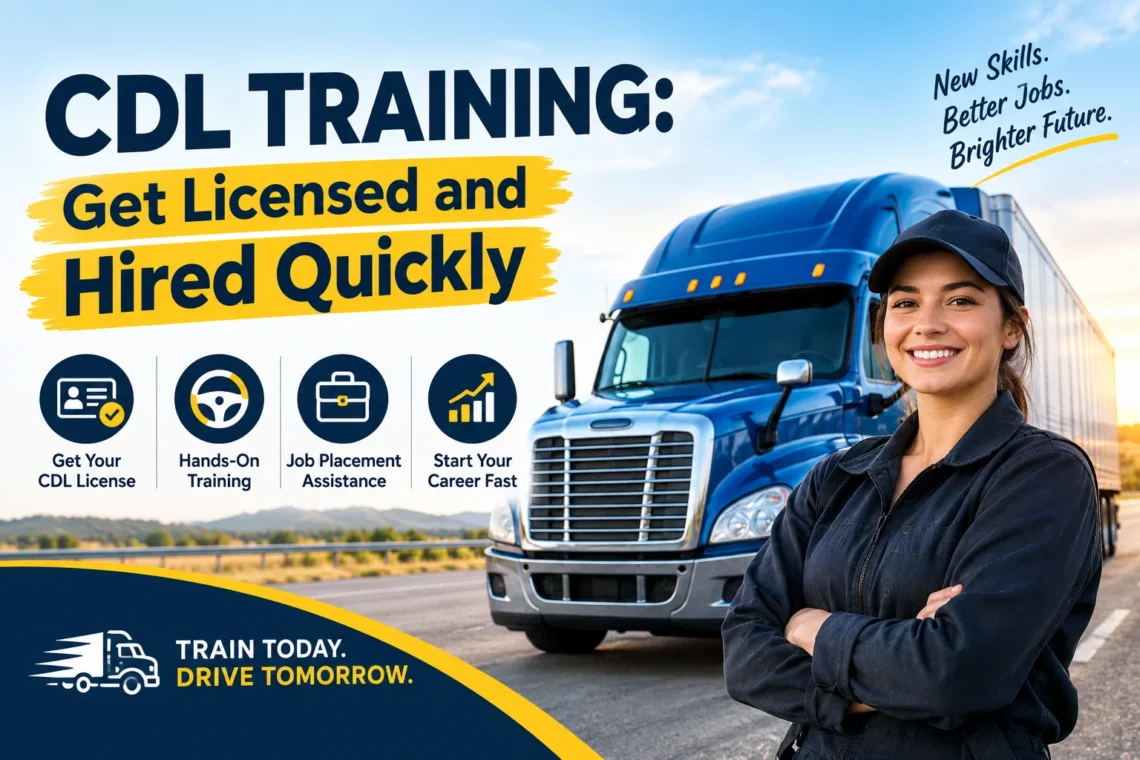
The transportation and logistics industry is the essential backbone of the global economy. Every product on a retail shelf, every raw material delivered to a factory, and every package arriving at a doorstep relies on commercial drivers. If you are looking for a career change that offers job security, rapid entry into the workforce, and solid earning potential without requiring a four-year college degree, earning a Commercial Driver’s License (CDL) is one of the fastest routes available.
Understanding CDL License Classes & Endorsements
Before enrolling in a training program, you must decide which type of commercial license aligns with your career goals. The Federal Motor Carrier Safety Administration (FMCSA) categorizes CDLs into three main classes based on vehicle weight and configuration.
License Class Breakdown
- Class A CDL: Required to operate any combination of vehicles with a Gross Combination Weight Rating (GCWR) of 26,001 pounds or more, provided the towed vehicle weighs over 10,000 pounds. This includes tractor-trailers, flatbeds, livestock carriers, and double/triple trailers. Class A offers the highest versatility and earning potential.
- Class B CDL: Required to operate a single vehicle with a Gross Vehicle Weight Rating (GVWR) of 26,001 pounds or more, or towing a vehicle not in excess of 10,000 pounds. This includes straight trucks, large buses, dump trucks, and box trucks.
- Class C CDL: Applies to vehicles carrying 16 or more passengers (including the driver) or transporting hazardous materials (HazMat) that do not meet Class A or B criteria.
High-Value Endorsements
Adding endorsements to your license takes minimal extra study time but opens doors to higher-paying specialized roles:
| Endorsement Code | Name | What It Allows You to Drive |
| N | Tank Vehicle | Haul liquid cargo in bulk tanks |
| H | Hazardous Materials | Transport dangerous goods (requires background check) |
| X | Combination | Tanker + HazMat combined |
| T | Double/Triple Trailers | Tow two or three trailers simultaneously |
| P | Passenger | Drive passenger buses |
| S | School Bus | Drive K-12 school transportation |
Prerequisites and Eligibility Requirements
To qualify for CDL training in the United States, candidates must fulfill basic legal and physical prerequisites before sitting behind the wheel.
- Age Requirements: You must be at least 18 years old to drive intrastate (within your home state) and at least 21 years old to transport cargo across state lines (interstate) or haul hazardous materials.
- Valid Driving History: A non-commercial driver’s license in good standing is mandatory. Serious traffic violations or suspensions may temporarily disqualify you.
- DOT Physical Examination: Drivers must pass a physical examination conducted by a certified Department of Transportation (DOT) medical examiner. This checks vision, hearing, blood pressure, and overall physical stamina.
- Drug and Alcohol Screening: Passing a DOT-mandated drug screen is required before obtaining a Commercial Learner’s Permit (CLP) and starting behind-the-wheel instruction.
Fast-Tracking Your CDL: The Training Process
Under the federal Entry-Level Driver Training (ELDT) regulations, all prospective CDL holders must complete a course provided by a registered training provider listed on the FMCSA Training Provider Registry (TPR).
Step-by-Step Pathway to Getting Licensed
- Theory & Classroom Instruction: Master road safety rules, federal hours-of-service regulations, vehicle inspection principles, and emergency maneuvers.
- Earn Your Commercial Learner’s Permit (CLP): Pass written knowledge tests at your local DMV to earn a permit, allowing you to practice driving under the supervision of a licensed CDL holder.
- Behind-the-Wheel (BTW) Range Training: Practice essential backing maneuvers, straight-line tracking, parallel parking, and alley docks on a closed control range.
- On-Road Driving Practice: Drive on public streets, highways, and urban corridors with an instructor to master gear shifting, turning radiuses, lane management, and defensive driving.
- Pass the Final CDL Skills Test: Complete the official three-part exam consisting of a Pre-Trip Vehicle Inspection, Basic Vehicle Control Skills Test, and Road Test.
Paid CDL Training vs. Private Trucking Schools
When looking to get licensed fast, choosing the right training model is key to balancing speed and cost.
Company-Sponsored (Paid) CDL Training
Many major logistics and trucking fleets operate dedicated training academies. They pay for your schooling—and often provide a stipend or hourly wage—in exchange for an agreement to drive for them for 9 to 12 months.
- Pros: Zero upfront tuition cost, guaranteed job upon graduation, fast-track hiring process.
- Cons: Bound by a contractual commitment; leaving early requires paying back tuition costs.
Private Truck Driving Schools
Private vocational institutes or community colleges offer independent CDL programs ranging from 3 to 8 weeks.
- Pros: Complete freedom to choose your employer after graduation; broader training options without contract restrictions.
- Cons: Out-of-pocket costs range from $3,000 to $8,000 (though tuition reimbursement programs from carriers are common).
How to Get Hired Immediately After Graduation
Getting licensed is only half the battle; getting hired quickly requires proactive planning during your school weeks.
- Take Advantage of Job Placement Assistance: Choose a school that hosts carrier recruitment days. Many students sign conditional job offers (pre-hires) before they even pass their final driving test.
- Keep a Clean Driving Record: Avoid traffic tickets or accidents during your training period, as carriers review motor vehicle records thoroughly.
- Target Companies Offering Tuition Reimbursement: If you paid for private school, choose a carrier that offers monthly tuition repayments added to your paycheck.
- Consider Endorsements Early: Having a Tanker or HazMat endorsement on your initial license makes your application stand out over candidates holding standard licenses.
Frequently Asked Questions
How long does CDL training take from start to finish?
Accelerated private programs and company-sponsored training courses generally take 3 to 4 weeks of full-time instruction. Part-time or community college programs may take 8 to 12 weeks.
Can I get a CDL with a bad driving record?
Minor traffic infractions usually will not prevent you from getting a CDL. However, major violations—such as DUI/DWI, reckless driving, or license suspensions within the past 3 to 5 years—can limit your ability to be hired by commercial fleets.
What is the difference between Class A and Class B CDL training?
Class A training covers heavy tractor-trailers (over 26,001 lbs GCWR with a trailer over 10,000 lbs) and requires mastering complex maneuvers like double-clutching and combination backing. Class B training focuses on single rigid vehicles like buses or dump trucks and generally takes less time to complete.
How much does CDL training cost if paid out of pocket?
Out-of-pocket tuition for a quality private CDL school ranges between $3,000 and $8,000, depending on your location and the depth of the program. Financial aid, grants, and carrier tuition reimbursement frequently help offset these costs.
Do companies hire CDL drivers immediately after graduation?
Yes. Due to continuous demand for freight haulers, many motor carriers actively recruit students directly from FMCSA-approved schools, frequently offering job placements prior to graduation.
Final Thoughts
Embarking on CDL training is one of the most practical and efficient investments you can make in your professional future. By selecting an FMCSA-registered school, preparing thoroughly for your CLP written exams, and mastering vehicle inspection routines, you can transition from an entry-level student to a professional commercial driver in under a month. With strong industry demand, job stability, and competitive starting pay, taking the driver’s seat today can pave the way toward long-term financial freedom.