




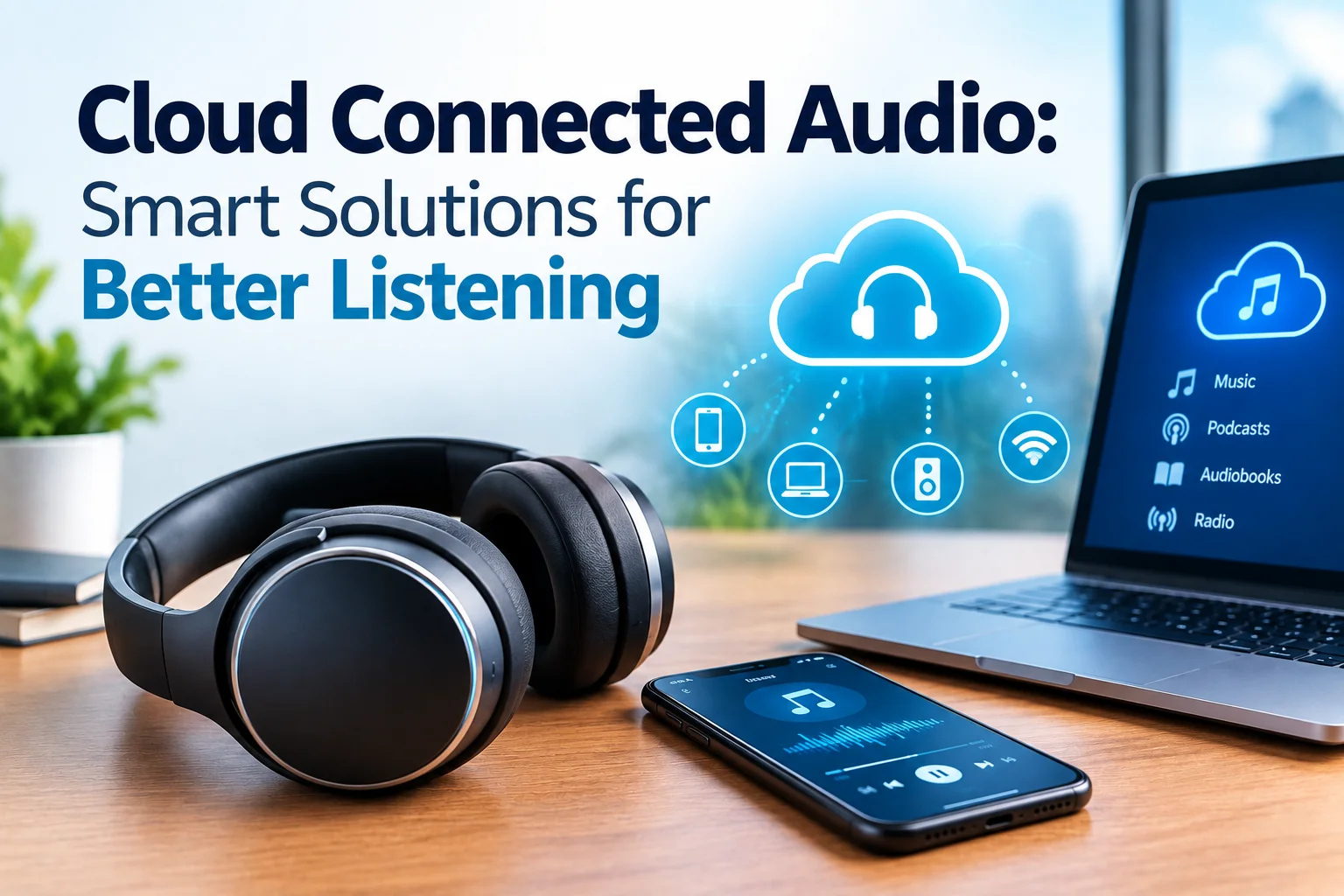
Cloud Connected Audio: Smart Solutions for Better Listening
The way audio is delivered, processed, and experienced has undergone a fundamental transformation. For decades, listening to music, podcasts, or television required direct physical connections or short-range point-to-point signals like traditional Bluetooth. Today, cloud-connected audio has redefined sound delivery. By leveraging high-speed Wi-Fi, edge computing, centralized cloud networks, and unified smart home protocols, cloud-connected sound systems offer unprecedented clarity, flexibility, and intelligence.
Technical Comparison of Audio Delivery Technologies
Understanding how cloud-connected audio differs from legacy technologies helps clarify why networked sound has become the standard for modern listening setups.
| Feature / Metric | Traditional Analog / Wired | Standard Bluetooth | Cloud-Connected Audio (Wi-Fi / IP) |
| Primary Data Path | Copper cables / AUX / Optical | Point-to-point RF transmission | IP network peering / Cloud direct stream |
| Audio Bandwidth & Resolution | Limited by source DAC & cable loss | Compressed (SBC/AAC); bandwidth capped | High-Resolution lossless (up to 24-bit/192kHz) |
| Transmission Range | Restricted by cable length | 10 to 30 meters line-of-sight | Unlimited (anywhere on local network or cloud) |
| Multi-Room Synchronization | Hard-wired distribution amplifiers | Unreliable / Limited stereo pairing | Microsecond-accurate zero-latency zones |
| Playback Independence | Tethered to physical source | Phone/device must remain nearby & awake | Direct hardware streaming; phone acts as remote |
| System Interoperability | Vendor-locked proprietary hardware | Universal device pairing | Cross-platform standards (Matter, AirPlay, Cast) |
Key Pillars of Cloud-Connected Audio
Cloud audio systems move the heavy lifting from playback hardware to external servers and cloud platforms. Instead of relying on a smartphone to decode an audio file and stream it wirelessly over short ranges, connected speakers pull data streams directly from the source over high-speed networks.
┌────────────────────────────────────────────────────────────────────────┐
│                        CLOUD AUDIO ROUTING ARCHITECTURE                │
└───────────────────────────────────┬────────────────────────────────────┘
                                    │
        ┌───────────────────────────┼───────────────────────────┐
        │                           │                           │
        ▼                           ▼                           ▼
┌───────────────────────┐   ┌───────────────────────┐   ┌───────────────────────┐
│     DIRECT CLOUD      │   │   AI ACOUSTIC ENGINE  │   │      MULTI-DEVICE     │
│       STREAMING       │   │                       │   │     SYNCHRONIZATION   │
│ • Bit-perfect FLAC    │   │ • Real-time room tuning│  │ • Microsecond syncing │
│ • Off-device decoding │   │ • Dynamic EQ balancers│   │ • Zone-based routing  │
│ • No phone battery drain│ │ • Noise suppression   │   │ • Matter / AirPlay    │
└───────────────────────┘   └───────────────────────┘   └───────────────────────┘
1. Lossless Direct-to-Device Streaming
When playing music via traditional Bluetooth, the phone decompresses audio files, re-encodes them into a lossy format, and transmits them across the room. If a call comes in, the audio interrupts.
Cloud-connected platforms (such as Spotify Connect, Tidal Connect, and Apple AirPlay 2) use smartphones merely as control interfaces. The connected speaker establishes a direct connection to the cloud servers over Wi-Fi, streaming uncompressed, bit-perfect high-resolution audio files without draining phone battery power or buffering during incoming notifications.
2. Intelligent Room Adaptation and AI Acoustics
Modern cloud audio equipment integrates real-time DSP (Digital Signal Processing) with cloud machine learning algorithms. micro-phones built into smart speakers analyze surrounding spatial dimensions, acoustic reflections, and physical obstructions. Cloud models process these spatial profiles, adjusting equalizer frequencies, channel delays, and dynamic range in real time to ensure optimal sound delivery regardless of room layout.
3. Unified Multi-Room Ecosystems
Legacy audio required complex receiver setups and physical speaker wires routed through walls. Cloud-connected systems allow users to group speakers into synchronized listening zones throughout a home or commercial property.
Through unified connectivity protocols like Matter, local IP networks coordinate audio timing down to the microsecond level. This eliminates echo and phase cancellation across multi-room setups, letting music follow listener movement seamlessly from kitchen to living area.
4. Enterprise Voice and Communication Clarity
Cloud-connected audio extends far beyond entertainment; it forms the backbone of modern remote collaboration. Enterprise cloud platforms utilize Session Border Controllers (SBC) and direct cloud peering to route voice data across private networks. By bypassing public internet traffic bottlenecks, these systems offer crystal-clear conferencing with AI-driven background noise cancellation and instant voice-to-text transcription.
Strategic Implementation Strategies
Building a reliable cloud audio infrastructure requires thoughtful network planning and hardware integration.
-
Establish a Robust Wi-Fi 6/6E Backbone: High-resolution cloud audio streams require stable, low-latency local bandwidth. Deploying a dedicated mesh Wi-Fi network ensures multi-zone systems maintain sync without dropouts.
-
Prioritize Open Interoperability: Look for hardware that supports cross-platform standards like Matter, Apple AirPlay, and Google Cast. This prevents ecosystem lock-in and allows mixing equipment across different manufacturers.
-
Optimize Network Quality of Service (QoS): In router settings, prioritize audio packet traffic over bulk downloads to prevent latency spikes during high-traffic network usage.
-
Utilize Dedicated Streamers for Legacy Hardware: Vintage amplifiers or high-end analog speakers can join cloud networks easily by connecting inexpensive, high-DAC Wi-Fi streaming bridges.
5 Frequently Asked Questions
1. Does cloud-connected audio require an active internet connection to function?
Yes, fetching high-resolution streams directly from servers requires internet connectivity. However, local network synchronization (playing stored local audio files across multiple rooms) works over local Wi-Fi even if external internet access drops.
2. Is sound quality noticeably better on cloud Wi-Fi speakers compared to Bluetooth?
Yes. Bluetooth compresses audio files to fit limited wireless bandwidth. Cloud audio over Wi-Fi delivers full uncompressed CD-quality and 24-bit studio-master lossless streams without compression artifacts.
3. Will phone calls or app notifications disrupt playback on a cloud speaker?
No. Because the speaker pulls music directly from the cloud rather than receiving an audio relay from your phone, calls, games, or system alerts play privately on the handset without interrupting music.
4. Can old analog speakers be converted into cloud-connected devices?
Yes. You can connect a network streamer or smart amplifier to the analog input (RCA or optical) of vintage audio equipment, instantly granting it cloud streaming, multi-room sync, and app control features.
5. How does cloud-connected audio handle privacy with built-in micro-phones?
Modern smart audio devices separate acoustic tuning from voice assistance. Most units feature physical hardware mute switches that disconnect internal micro-phones entirely, allowing spatial room-tuning routines to run while ensuring conversational privacy.
Final Thoughts
Cloud-connected audio has transformed listening from a static, wire-tethered activity into a intelligent, scalable digital service. By decoupling physical sources from audio reproduction and harnessing the power of high-speed wireless networks, connected sound systems deliver studio-grade fidelity, dynamic room calibration, and effortless multi-zone control. Investing in smart, open-standard connected audio infrastructure ensures your sound setup remains adaptable, immersive, and aligned with future digital innovations.




3 thoughts on “Cloud Connected Audio: Smart Solutions for Better Listening”